Use case 02
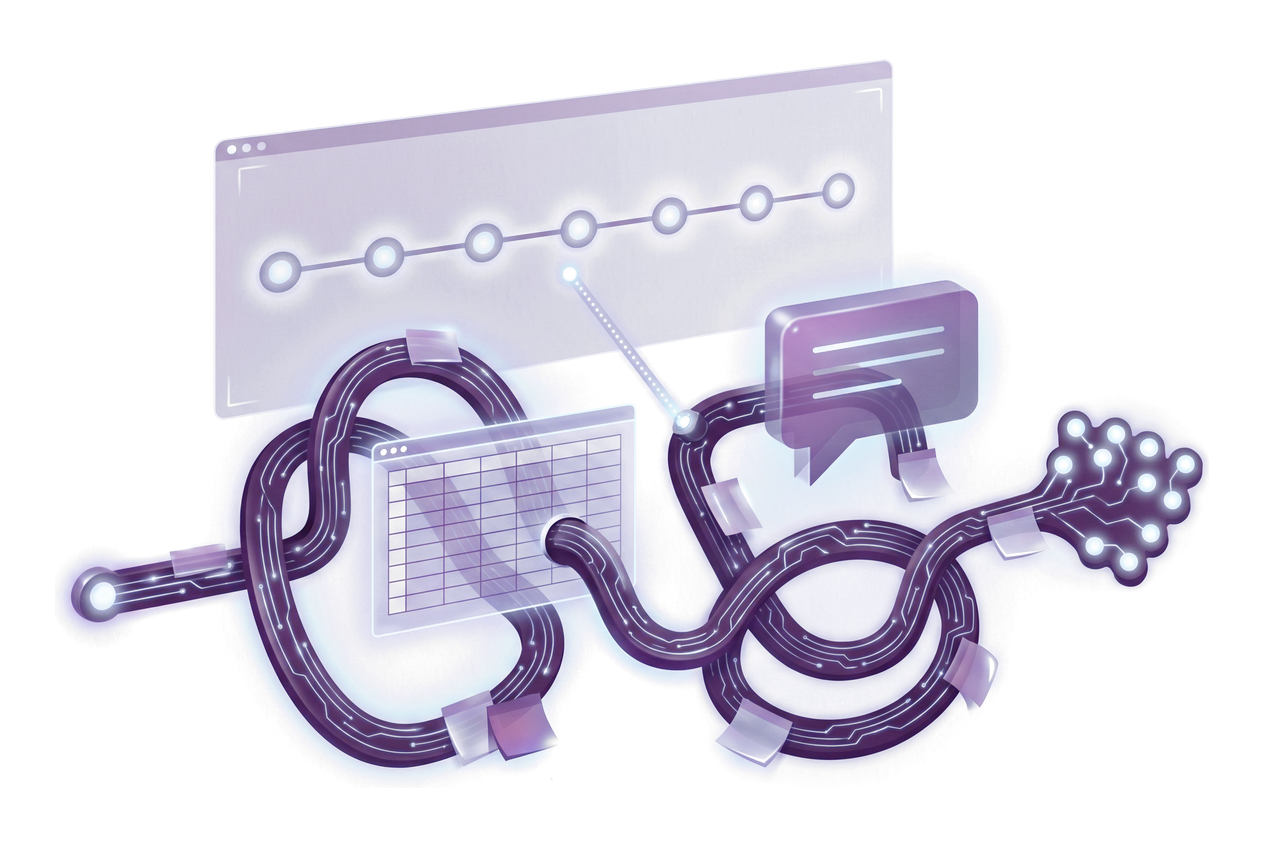
The as-believed map and the as-recorded map
For operations & CI leaders
Published · By Junil Kim, CEO & Co-founder
The current-state map records what people say they do. The recoverable time sits in the gap between that and what they actually do.
A current-state process map built in a workshop records the process as people remember it. An as-recorded map is built from observed work, so it captures the handoffs, rework loops, and exception paths that memory leaves out. The recoverable time sits in the gap between the two.
Aperture is a workflow discovery tool that creates a current-state process map from observed work rather than workshop recall alone. It shows operations and continuous-improvement teams how transactional processes actually run, including handoffs, exceptions, rework, and off-system steps.
The current-state map took three weeks to prepare and two days to draw. Everyone in the workshop told the truth as they understood it. When the map went up on the wall, it looked complete.
But it was still a map of the work as believed.
A workshop can capture only what people remember and can explain. No one can fully reconstruct an ordinary Tuesday from memory.
Why is the current-state process map always becoming stale?
The gap is not anyone's fault. Standard work drifts naturally. An exception becomes routine. Someone invents a workaround only one person knows to keep orders moving. A new hire learns the workaround instead of the official process.
None of those changes makes it back onto the wall.
Over time, the map and the work quietly diverge. The value stream shows eight steps; the desk performs eleven. Two of those steps exist only because of a system limitation everyone stopped noticing years ago.
Why do time studies miss transactional work?
For line work, the answer has always been to go and see. Gemba works because the work is visible. You can stand at the line, watch the motion, and time the cycle.
Transactional work is harder to observe. Order entry, claims, billing, and scheduling unfold across screens, inboxes, and spreadsheets. Walk past the desk and all you see is someone typing. The stopwatch has nothing useful to time, so the time study returns an estimate dressed up as precision.
What is an as-recorded process map?
An as-recorded process map is a current-state map drawn from observed work rather than workshop recall. It shows each handoff, rework loop, and exception path with time attached, so the map matches what the desk actually does on an ordinary Tuesday.
Aperture builds exactly that: it records how transactional work actually runs and organizes it into named workflows.
Place the as-recorded map next to the as-believed one. The gap between them becomes a ranked waste list: the rework loop no one mentioned, the approval sitting in an inbox for two days, the re-keying step created by systems that never learned to talk.
This does not replace going to see. It extends the same discipline of direct observation to office work the stopwatch cannot reach, and it produces evidence you can put beside the map.
How do the two maps compare?
Side by side, the differences are easy to read. The as-believed map is what lean teams also call the as-is process map; the as-recorded map is its evidence-backed counterpart.
| As-believed map | As-recorded map | |
|---|---|---|
| Built from | Workshop recall | Observed work |
| Exceptions | The ones people remember | Every path that occurred |
| Freshness | Stale as standard work drifts | Current as of capture |
| Time data | Estimates | Recorded durations |
| Role in kaizen | Starting sketch | Evidence beside the sketch |
What should you bring to the next kaizen event?
The practical setup is simple: one team and one or two weeks of capture.
You walk into the next kaizen event with a current-state map drawn from observed work and a ranked list of waste, with hours and dollars attached: a mapping artifact instead of another workshop. The session can begin where it should: deciding what to fix, not reconstructing what happens. The same evidence closes the gap between plan and reality upstream in planning.
If your team has ever finished a mapping workshop suspecting the real process was still hiding, bring that suspicion to a conversation. Talk to the founders.