Field notes
Operational debt
Field notes from CPG supply chains
Published · By Junil Kim, CEO & Co-founder
Nobody we met was short on data. They were short on the system that should have connected it, and the interest on that deferral is now due.
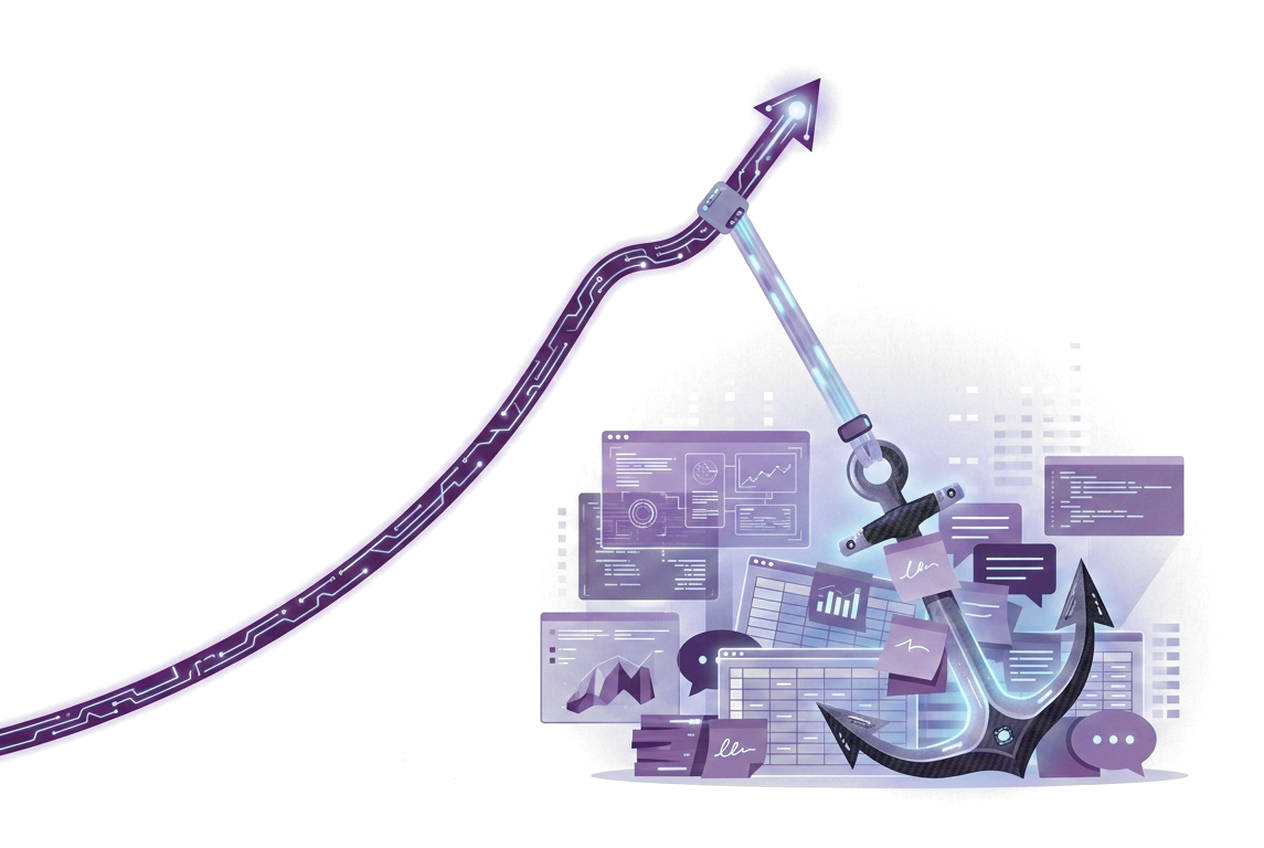
Operational debt is the cost a company accrues by running core operations on spreadsheets, chat threads, and one person's memory past the point where those tools fit the business. Like technical debt, it is cheap to take on and expensive to carry. This post collects what we have learned about it inside consumer goods companies over the past few months: where it accumulates, what operators actually want, and why the fix is rarely a new system.
Aperture is an AI-native operations tool. Our first deployments are inside the planning, purchasing, and inventory loops of consumer goods companies: we map how the work actually runs, then deploy agents inside the files that work already lives in. These are our field notes from the mapping.
Where the term came from
An executive at a manufacturer we work with used the phrase first. The company wanted to open new sales channels and could not. Every new channel meant another admin console, another export format, another set of numbers for one person to reconcile by hand each morning. Nothing was broken. The company had simply deferred systematizing its operations for years, and the deferral had compounded into a constraint.
That is the defining feature of operational debt. It does not show up as a cost line. It shows up as things the company wants to do and cannot.
Note 1: The ERP keeps the books. Excel runs the business.
Every company we visited had an ERP. Not one of them ran on it.
At a typical company, the ERP is updated once a month, between the 11th and the 15th, with the previous month's figures. It exists for accounting and audit. Daily operations happen somewhere else: local Excel files, Google Sheets, and group chats.
The reason is structural. The ERP's schema is fixed, so product specs that do not fit a field get typed into the item name. Planning logic that the ERP cannot express gets rebuilt in a spreadsheet next to it. Over time the spreadsheet becomes the system of record and the ERP becomes a reporting obligation.
This is not a Korean quirk or a mid-market quirk. Only about 32% of planners actually move onto the planning tool their company implemented, according to polling at Gartner's 2024 Supply Chain Planning Summit. In a BluJay and Adelante SCM survey of 140 executives, 67.4% counted Excel as one of their supply chain systems. The spreadsheet wins because it gives the planner sub-second feedback, formulas they own, and total layout freedom. No planning portal offers all three.
Note 2: The morning roll-up
At one consumer goods company, a single person starts each day by logging into six platforms: two marketplaces, a retailer's supplier portal, a third-party logistics site, and two more. She copies yesterday's sales and today's stock out of each one, translates each platform's product codes into the company's internal codes, and pastes the result into one workbook.
That workbook is the company's inventory picture. Sales plans against it. Purchasing orders against it. Nobody else can produce it.
Distributor stock arrives separately, once a week, as an emailed spreadsheet that is frequently wrong about goods in transit and expiry dates. Someone reconciles that by hand too.
We wrote about the key-person risk in this pattern before. The operational-debt view is slightly different: the roll-up is not a knowledge problem. It is an integration the company never built, being performed by a person every morning instead.
Note 3: Nobody holds the master record
Ask three teams for the list of products and you get three lists. Development keeps specs. Sales keeps revenue categories. Purchasing keeps the manufacturer and OEM mapping. The internal wiki exists, but each team copied it and edited its own copy, so there are now several.
Purchasing at one company works across five systems for a single order: the ERP, Excel, email, the customs declaration portal, and a separate regulatory filing site for products classified as medical goods. Each OEM sends invoices in its own format and its own units. One quotes rolls, another layers, another packs, and the ERP wants boxes. Every conversion is a manual step, and every manual step is a place for the numbers to drift.
Note 4: The plan is 60% right, and that is fine
We expected planners to complain about forecast accuracy. They did not. Several told us that a plan that turns out 60% right is a good plan.
The timing mismatch is simply too large to plan around. Retail channels confirm a promotion seven days to two weeks ahead. Sometimes the confirmation arrives the day before. Production was committed two to three months earlier, and raw materials before that. Export orders leave in container-sized lots that firm up three to four weeks out. The plan and reality were never going to match.
What operators actually suffer from is detection latency. An OEM promises delivery "in the second week of September," then slips, and the slip is mentioned in a chat thread nobody is watching. No alert fires. The purchase order that should have covered the promotion goes out late. Shipped quantity and received quantity disagree, and tracing the cause (a mislabeled pallet, a handwritten count, a lost carton) takes hours.
The 60% plan is not the debt. The three days it takes to notice the plan is off is the debt.
Note 5: The debt shows up as missed growth before it shows up as cost
Overstock and understock both come out of the same gap, and both are expensive in ways the P&L hides.
Understock is the loud one. At one company, promotions were being held back because supply could not support them. The headline finding of our engagement there was not a cost item. It was revenue the company chose not to pursue.
Overstock is the quiet one. In hygiene products and food, excess inventory does not sit in a warehouse; it expires. Every planner facing uncertainty rounds up, because a stockout is visible and excess is not, and the rounding becomes write-offs.
There is a third cost that surprised us. At one brand, the finance analyst spends most of the month updating operational numbers by hand, and the actual close gets squeezed into whatever time is left. At another, purchasing tracks a 30% prepayment per order and has to map it, container by container and at two different exchange rates, back to the landed cost of each item. None of that is finance work. It is operational debt being serviced by whoever is closest.
And there is the hero-SKU effect. One product gets the executive attention, the weekly review, and the growth plan. The remaining few hundred SKUs, often half of revenue, accumulate dead stock in the dark.
What operators told us they want
When we asked what would help, the answers were consistent and modest.
- To know when a shipment is arriving without having to ask.
- An alert when sales spike or a lead time slips, instead of finding out in the next meeting.
- Plan and actual side by side, so purchasing can react when a channel outperforms.
- A draft purchase order they can review rather than write.
- A supplier's email reply reflected in the sheet automatically.
- A warning when stock is approaching expiry.
- One product master that updates itself.
- A forecasting sheet that loads. One team runs roughly 500 SKUs across ten channel tabs, and the file has become too heavy to use.
And one thing they did not want: to leave Excel.
Why they do not just buy a system
Founders and operators gave us versions of the same three reasons.
The first is a threshold. One founder told us that up to roughly $100 million in revenue, optimizing people paid off far more than optimizing technology. A new tool that takes a year to teach and stabilize is a risk the company cannot justify at that size.
The second is scar tissue. The same company piloted a company-wide AI assistant and rolled it back because productivity fell. Another replaced a dashboard with a spreadsheet, on purpose, because the team could edit and extend the spreadsheet themselves. Adoption is not a rollout problem. It is a question of whether the tool lives where the work already lives.
The third is who feels the pain. The CEO is focused on growth, and rightly so. The urgency sits with the CFO, the COO, or the supply chain lead, who service the debt every day. Any solution has to connect to volume or SKU expansion, not to "visibility" as an abstract good, before it earns attention at the top.
Paying it down without a migration
Paying down operational debt does not start with a new system. It is three moves, and none of them is "replace the spreadsheet."
1. Record the loop as it runs. We start with one loop, end to end: the morning roll-up, the purchase order, or the distributor reconciliation. Aperture records the work from the real screens: which portal was opened, which column was copied, which product code was translated into which, where a number was retyped and where it was rounded. Every handoff and exception is captured rather than described in an interview. That recording becomes the ground truth every later decision inherits, and it is usually the first time anyone has seen the whole loop in one place.
2. Register the truth underneath the sheet. The recording exposes what the spreadsheet has been carrying silently: the product-code mappings between six platforms and the internal catalog, the unit conversions from rolls and layers to boxes, the cells that are hand-typed constants, the lead-time assumptions that exist only in someone's head. Each of these becomes a named rule with an owner. The spreadsheet stays exactly where it is and looks exactly the same. What changes is that the logic under it now has a source the company controls, so the roll-up stops being an integration performed by a person.
3. Put an agent on the loop. With the rules registered, automation arrives already knowing how this company's files are built. The first agent takes the narrowest, highest-latency job: pull yesterday's sales and stock from each platform, translate the codes, write the roll-up, and flag what moved. Then the alerts operators asked for: a lead time slipped past the promotion date, a channel is outrunning the plan, a lot is approaching expiry, a supplier's reply landed in email and the sheet has not caught up. Draft purchase orders come next. Every write to a sheet is reviewed by the person who owns it, and nothing goes live without their sign-off.
What Aperture delivers
The engagement is sold as a four-week diagnosis, and the first agent ships inside the first week.
- Week one: the first loop, recorded and automated. We record the first loop and ship the first agent against it, usually the roll-up or the plan-versus-actual gap. Operators see something working on their own files before the diagnosis is finished.
- Weeks two to four: the map. Order-to-delivery, end to end: sales plan, purchasing, outsourced production, logistics, settlement. Each bottleneck is priced in hours and dollars, and each assumption is tagged to the person who can confirm it.
- The ranked backlog. What to automate, what to leave alone, and in which order, with the value of each item priced against what it costs to build. This is where the operator wishlist above turns into a sequence.
- The standing view. Plan against actual, inventory by channel, open orders and supply commitments, in one screen the owner and the operators look at together, with alerts routed to the person who can act.
What the company keeps is a map it owns, agents that live inside the files it already uses, and a picture of its own operations that updates without anyone building it by hand each morning. You can read how this ran inside a PE-backed consumer goods company.
Why this clears the three objections
The threshold: there is no rollout to survive, because there is no new system to train anyone on. The scar tissue: the tool lives where the work already lives, in the spreadsheet the team already edits and extends. The attention: the diagnosis prices the operational debt in held-back promotions and expiring stock, which is the language the CEO is already listening to.
If your operations run on spreadsheets that one person understands, we can show you where the debt is and what it is costing. Talk to the founders.